%20-%20Edited%20-%20Edited%20no%20cap.png)
Al Maktoum International Airport (DWC): Dubai’s Next Big Investment Corridor
- praptibhat
- Dec 16, 2025
- 3 min read
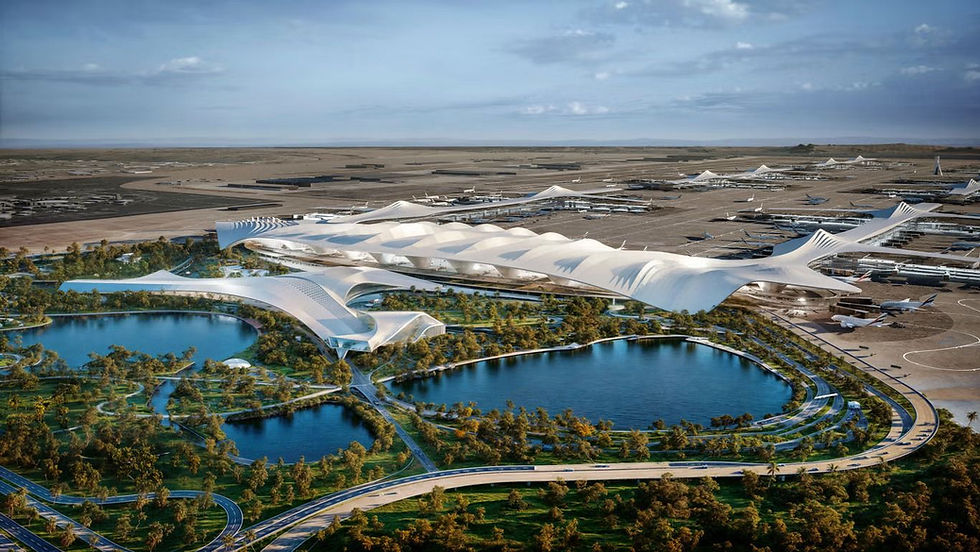
Dubai is building what is set to become the largest airport in the world—and it’s not just an aviation story. The AED 128 billion expansion of Al Maktoum International Airport (DWC) is quietly reshaping the future of real estate, infrastructure, and investment returns in the southern part of the city.
Located in Jebel Ali, DWC sits at the heart of Dubai South, a master-planned city spanning 145 sq. km. Once fully developed, the airport is designed to handle 260 million passengers annually and 12 million tonnes of cargo, supported by five parallel runways and nearly 400 aircraft gates. This scale positions DWC not just as an airport, but as the anchor of a global economic ecosystem.
Dubai International Airport (DXB), despite its success, is approaching its physical limits. Surrounded by dense urban development, further expansion is neither practical nor efficient. As a result, Dubai’s long-term aviation strategy is clear: a phased migration of all operations— including Emirates—from DXB to DWC, with full transition expected between 2032 and 2034. Airlines have already begun shifting traffic as DXB nears capacity, marking the start of a structural
change rather than a distant plan.
Once this transition is complete, Dubai South will effectively become the city’s new aviation and logistics nucleus. The eventual redevelopment of the DXB site—while still unannounced—will further reinforce this southward shift by easing congestion in older parts of the city and unlocking prime northern land for future urban use.
For investors, this transformation follows a proven global model known as an “aerotropolis”—a city built around a major international airport. History shows that real estate values in such zones tend to rise steadily as jobs, population, and infrastructure follow.

Dubai South is projected to support over 500,000 jobs and house nearly 1 million residents, creating sustained demand for both residential and commercial property. Residential investors benefit from rising rental demand driven by aviation, logistics, and Expo City professionals, while commercial and industrial investors gain access to free-zone advantages such as 100% foreign ownership and zero corporate tax.
A key advantage today is pricing. Property values in Dubai South remain significantly lower than central Dubai, offering a strong entry point before large-scale population inflows and airport-led demand are fully priced in. With planned infrastructure upgrades—including new road networks and the potential Dubai Metro Blue Line extension—connectivity and accessibility are set to improve sharply over the coming years.
Market analysts widely view 2025 onwards as the optimal entry window. The airport’s masterplan received formal approval in April 2024, with construction already underway—signalling firm government commitment rather than speculative intent. Investors entering at this stage benefit from early-mover pricing while positioning themselves ahead of the 2032–2034 transition timeline.
Current investor focus is on:
Off-plan opportunities in developments such as Emaar South, South Bay, and Expo City Residences, offering flexible payment plans and medium-term capital appreciation.
Rental-yield assets in communities like MAG 5 Boulevard and Remraam, which cater to the growing aviation and logistics workforce.
In essence, Al Maktoum International Airport is not just an infrastructure upgrade, it is a long-term economic anchor shaping Dubai’s next phase of growth. With government-backed capital, a clearly defined transition timeline, and rising demand across residential, commercial, and logistics sectors, Dubai South real estate is emerging as one of the most compelling investment themes in the city.
For investors seeking strong rental yields, long-term capital appreciation, and early entry into a prime growth corridor, the DWC–Dubai South region offers a rare combination of scale, policy support, and value pricing. As aviation activity gradually shifts south and infrastructure milestones are delivered, assets acquired today are well-positioned to benefit from the compounding effects of
demand, connectivity, and economic concentration.

Comments